
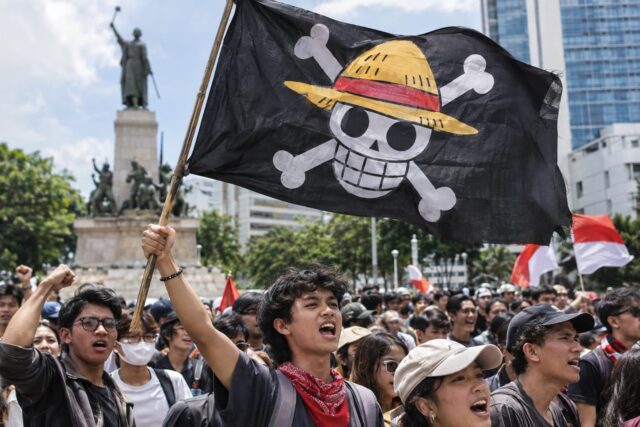
In September 2025, an unusual black flag appeared outside Nepal’s parliament. It featured a grinning skull wearing a yellow straw hat, an image familiar to millions of manga and anime fans. Similar flags had already appeared in Indonesia and would soon be seen at demonstrations in the Philippines and Madagascar. What began as a fictional pirate emblem had become a recognizable symbol of youth-led political protests.
The flag comes from One Piece, a Japanese manga series created by Eiichiro Oda in 1997. Its appearance at demonstrations raised an interesting question: why were young protesters carrying a symbol from popular entertainment rather than relying exclusively on traditional political banners? The answer involves the story’s themes, the international reach of anime, and the changing visual language of public demonstrations.
From Fictional Pirates to Real Demonstrations
In One Piece, Monkey D. Luffy leads the Straw Hat Pirates on a journey across a fictional world controlled in part by a powerful World Government. Throughout the series, the crew encounters corrupt officials, authoritarian rulers, discrimination, and communities struggling against powerful institutions. Although the story is primarily an adventure, questions about freedom, loyalty, justice, and authority frequently influence its plot.
The crew’s Jolly Roger, a skull and crossbones wearing Luffy’s distinctive straw hat, originally represents their identity as pirates. Its meaning changes when the image appears at a political demonstration. For some participants, it expresses distrust of established authorities. Others associate it with solidarity, independence, or the determination of fictional characters to challenge more powerful opponents. These interpretations are not necessarily identical, but the symbol is recognizable without requiring a detailed political explanation.
How Indonesia Brought the Flag Into the Spotlight
The flag attracted international attention in Indonesia during August 2025, particularly ahead of the country’s Independence Day celebrations. People displayed it outside homes, on vehicles, and at public gatherings. Its appearance reflected dissatisfaction with political leadership, economic conditions, and perceived government privileges. As demonstrations expanded later that month, the emblem became increasingly visible in protest coverage.
Some Indonesian officials reacted critically, suggesting that displaying the pirate flag could threaten national unity. Statements from government figures raised questions about whether its use might carry legal consequences. Human rights organizations subsequently expressed concern about reported intimidation of people displaying the symbol. The controversy demonstrated how an image from entertainment could acquire political significance once authorities and protesters began interpreting it differently.
However, Indonesia did not invent the idea of using anime imagery at demonstrations. The Straw Hat emblem had appeared in earlier protest settings, including demonstrations in 2023. What changed in 2025 was its visibility and rapid international recognition.
One Flag, Different Political Grievances
In Nepal, the image became associated with major protests in September 2025. Demonstrations initially intensified following restrictions on social media platforms, alongside widespread anger over alleged corruption and political privilege. The unrest resulted in deadly confrontations and the resignation of Prime Minister K. P. Sharma Oli. Images of the pirate flag near government buildings circulated internationally, making it one of the most recognizable symbols of the protests.
In the Philippines, the same emblem appeared during September demonstrations concerning alleged corruption involving flood-control infrastructure projects. Protesters questioned how public funds had been allocated and whether promised improvements had been delivered. Although the underlying controversy differed from Nepal’s, participants used the familiar pirate imagery to communicate dissatisfaction with political accountability.
Madagascar provided another distinctive example. Youth-led demonstrations began in September 2025 amid anger over recurring electricity outages and water shortages. The movement later expanded to broader economic and political grievances. Protesters adopted the One Piece emblem but modified its appearance, replacing the original straw hat with a traditional Malagasy bucket hat known as the satroka, worn by the Betsileo people. This adaptation preserved the internationally recognizable skull while connecting it to local cultural identity. After several weeks of demonstrations, the uprising ended with the country’s president removed from power in a military takeover.
These movements were not branches of a single organization. Their participants had different demands, national circumstances, and political objectives. The pirate flag offered a shared visual reference without establishing a common political program.
Why Generation Z Recognizes This Symbol
Traditional protest symbols often represent established parties, trade unions, or historical movements. Their meanings can be powerful, but they may also be closely associated with particular organizations or political traditions.
The One Piece flag operates differently. It comes from entertainment consumed internationally through manga, television, streaming platforms, and online communities. People who have never participated in the same organization may still recognize Luffy’s straw hat immediately.
This familiarity makes the emblem particularly adaptable to online communication. Photographs and short videos featuring the flag can circulate across national borders without lengthy explanations. Viewers recognize the image first and may then investigate the demonstration in which it appears.
Its popularity also reflects how contemporary protest culture incorporates humor, memes, and references from entertainment. A symbol does not need to originate within a political institution to acquire political meaning. Its significance can develop through repeated public use and the interpretations attached to it.
Yet the label “Gen Z protest” should not imply that an entire generation shares one political identity. Participants within these movements differ in age, political views, and expectations. The pirate flag is one recognizable element of their public imagery, not a comprehensive description of their beliefs.
From Viral Image to Lasting Protest Symbol
The emblem continued appearing beyond the initial demonstrations of 2025. During that autumn, it was also seen at protests in Morocco and France and, in October 2025, at “No Kings” demonstrations in the United States. In October 2026, an Indian student activist wore a One Piece T-shirt during a protest in Delhi concerning revisions to electoral rolls. The incident attracted media attention because it connected a familiar fictional symbol with another contemporary political dispute.
Its continued use illustrates how an image can move between countries and political contexts without retaining precisely the same meaning. In one location, it may represent frustration over corruption. Elsewhere, it may express dissatisfaction with public services or simply provide a recognizable sign of solidarity.
Nevertheless, a widely shared image cannot explain why a protest begins, how participants organize, or whether their demands succeed. Social media visibility is not equivalent to political influence, and the popularity of a symbol does not guarantee agreement among those displaying it.
The Straw Hat flag has become part of the visual history of recent youth-led demonstrations because it connects familiar fiction with real public grievances. It has not universally replaced party banners, national flags, or established protest imagery. Instead, it demonstrates how popular culture can provide an additional language through which people communicate political concerns.
The pirate emblem’s journey from manga pages to streets across several continents reveals a change in protest symbolism. Images once associated primarily with entertainment can acquire new meanings when audiences bring them into public life. For a digitally connected generation, a recognizable fictional flag may communicate an idea before a traditional political slogan is even read.

MOST COMMENTED
Largest protests
Pirate Flags Instead of Party Symbols: How One Piece Became an Emblem of Gen Z Protests
Student protests
Digital Security and Personal Data Protection: From Social Media to Online Casino Platforms
Student protests
Global Economic Trends and Their Impact on the Development of the Online Casino Entertainment Sector
Largest protests
How Leaderless Protests Work: Horizontal Movements and Collective Decision-Making
Forms of protests
The Right to Protest: How Rallies and Pickets Influence a Democratic Society
Forms of protests
Digitalization of Protest: How Social Media and Technology Are Changing Street Demonstrations
Largest protests
Digital Technology Revolution – Reshaping Modern Activism